

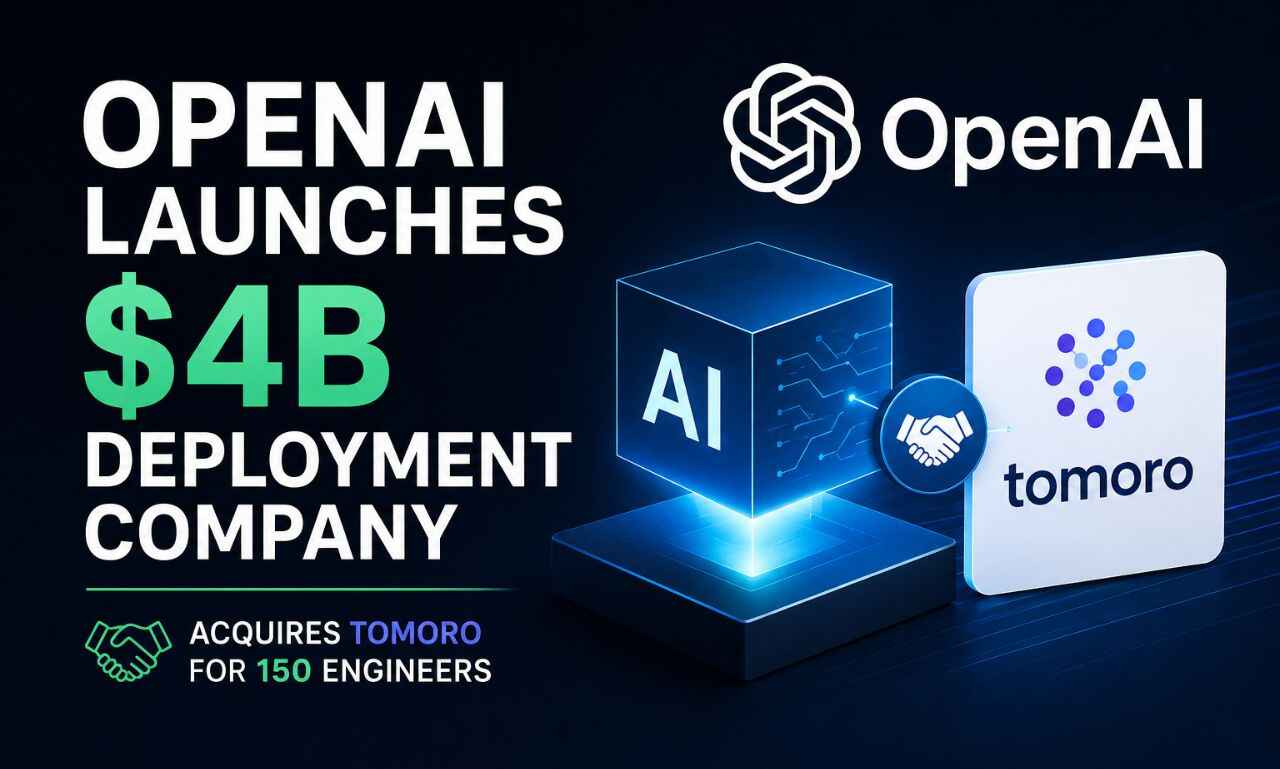
OpenAI on Monday launched the OpenAI Deployment Company, a standalone $4 billion business unit built to embed AI engineers directly inside client organizations, and announced the acquisition of Tomoro, a London-based AI consulting firm that brings approximately 150 engineers to the venture from day one. The new subsidiary launched with $4 billion in funding and is reportedly valued at $14 billion, with OpenAI retaining majority ownership and control.
In This Article
ToggleWhat the Deployment Company Actually Does
The OpenAI Deployment Company will extend OpenAI’s ability to embed engineers specialized in frontier AI deployment — known as Forward Deployed Engineers, or FDEs — into organizations working on complex problems in demanding environments. These engineers work inside client companies to redesign workflows and connect OpenAI models to existing data and business systems.
A total of 19 investors, consultants, and system integrators are involved, including Goldman Sachs, SoftBank, Warburg Pincus, BBVA, and consulting firms Bain & Company, Capgemini, and McKinsey. TPG leads the partnership, with Advent, Bain Capital, and Brookfield as co-lead founding partners.
“AI is increasingly capable of doing meaningful work within organizations, and the challenge now is helping companies integrate these systems into the infrastructure and workflows that drive their business,” said OpenAI Chief Revenue Officer Denise Dresser.
The Tomoro Acquisition
OpenAI’s subsidiary acquired Tomoro AI Ltd., a London-based technology services firm whose client roster includes Virgin Atlantic and Tesco, the UK’s largest retailer. The acquisition adds around 150 FDEs and technical specialists to the Deployment Company immediately.
The acquisition is expected to close within months, subject to customary closing conditions. OpenAI Deployment Company also plans to acquire additional firms using its $4 billion initial investment.
Tomoro was founded two and a half years ago and previously built AI systems for Virgin Atlantic, Tesco, Mattel, Red Bull, and gaming company Supercell.
The Palantir Playbook — And Why It Matters
Both Anthropic and OpenAI announced enterprise deployment ventures within weeks of each other — Anthropic’s joint venture valued at $1.5 billion backed by Blackstone, Hellman & Freeman, and Goldman Sachs, and OpenAI’s at $10 billion from 19 investors — with zero investor overlap between the two.
The move intensifies competition in the enterprise AI sector, where rivals including Anthropic, Palantir, and major consulting firms are racing to capture growing corporate demand for AI implementation services. The FDE model was popularized by Palantir, whose stock returned over 640% in five years after embedding engineers inside government and enterprise clients.
OpenAI’s investment and consulting partners sponsor more than 2,000 businesses globally — that network forms the Deployment Company’s immediate sales pipeline from launch.
What's Next
The Tomoro acquisition still requires regulatory approval and is expected to close in the coming months. Watch whether OpenAI closes additional firm acquisitions before year end — the company has signaled more deals are coming. Palantir’s US commercial contract bookings growth already dropped from 137% to 45% last quarter — a signal that OpenAI’s push is already applying real competitive pressure.