
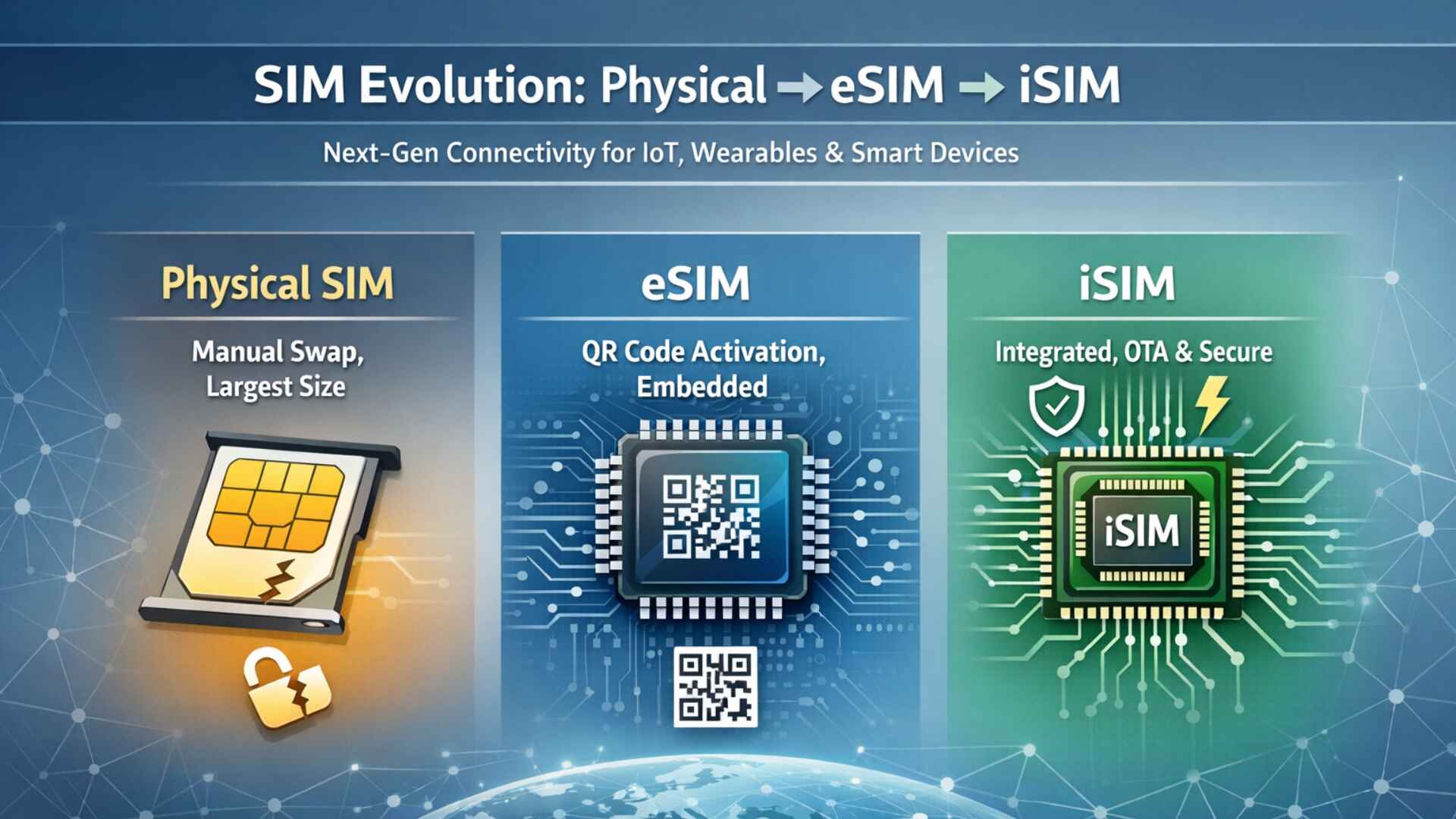
As of February 2026, the telecommunications industry has reached a pivotal inflection point. While eSIM technology successfully decoupled cellular identity from physical plastic, the Integrated SIM (iSIM) has effectively moved that identity into the very “brain” of the device: the System-on-Chip (SoC).
For enterprises and OEMs in the USA and UK, the transition to iSIM is no longer a futuristic roadmap item—it is a live deployment reality. With the number of active iSIM connections hitting 10 million this year and projected to skyrocket to 210 million by 2028, the industry is witnessing a total virtualization of device identity.
In This Article
ToggleThe Technical Edge: Benchmarking the iSIM Revolution
The shift from a soldered eSIM chip to an integrated iSIM logic core provides three non-negotiable advantages for 2026 hardware design: miniaturization, extreme power efficiency, and reduced manufacturing complexity.
| Feature | Physical SIM (4FF) | eSIM (MFF2) | iSIM (iUICC) |
|---|---|---|---|
| Physical Component | Removable Plastic | Soldered Chip | Integrated Logic in SoC |
| Footprint | 123.5 $mm^2$ | 30 $mm^2$ | < 1 $mm^2$ |
| Size Reduction | Baseline | ~75% vs. SIM | 98% vs. eSIM |
| Power Consumption | High | Moderate | Up to 70% Lower |
| Design Impact | External Slot | Internal Space | "Invisible" Integration |
1. The 2026 Wearable Frontier: Qualcomm and Apple
In the consumer space, 2026 is the year of the “Invisible Wearable.” The launch of the Qualcomm Snapdragon W5+ Gen 2 platform in late 2025 has redefined the smartwatch market. This 4nm SoC architecture is the first to natively support NB-NTN (Narrowband Non-Terrestrial Network) satellite messaging, a feature debuted in the Google Pixel Watch 4.
By integrating iSIM functionality, these platforms have reduced their RF Front End (RFFE) size by 20%, allowing for thinner, more ergonomic designs without sacrificing the 10–15 year battery life expected of industrial-grade sensors. Meanwhile, rumors surrounding the Apple Watch Ultra 4, expected in September 2026, point to a new S11 chip and an array of eight underside sensors that rely on the high efficiency of integrated connectivity to manage constant biometric data feeds.
2. SGP.32: The Global "Push" Standard for Massive IoT
The most significant operational shift in 2026 is the maturity of the GSMA SGP.32 standard. For years, the IoT industry struggled with the older M2M (SGP.02) standard, which relied on awkward SMS triggers that often failed on low-power networks.
SGP.32 replaces SMS with IP-based protocols (CoAP/UDP/DTLS), enabling a “Push” model of provisioning. This allows centralized enterprise departments to provision millions of devices—from smart streetlights to logistics trackers—simultaneously and remotely.
- Zero-Touch Deployment: Devices are now “born connected.” A single hardware SKU can be shipped globally, and the local operator profile is pushed to the device upon first power-up.
- Carrier Agility: SGP.32 eliminates vendor lock-in, allowing UK and US enterprises to switch connectivity providers en masse to avoid permanent roaming restrictions or to optimize for local data rates.
3. Security: The Integrated Root of Trust
Security is the primary driver for iSIM adoption in regulated sectors like healthcare and national infrastructure. Unlike discrete SIMs, the iSIM resides within a Tamper-Resistant Element (TRE) or a secure enclave inside the SoC.
- iTRE Certification: Leading 2026 chipsets have achieved Common Criteria EAL5+ certification, meeting military-grade standards for cryptographic data protection.
- Chip-to-Cloud Integrity: By using iSIM as a hardware Root of Trust (RoT), devices can provide verifiable data integrity. This is critical for the rise of “Agentic AI” in 2026, where autonomous drones and robots must prove their identity before executing real-world commands.
4. Regulatory Landscape: USA and UK Compliance
Governments in the USA and UK have introduced strict “Secure by Design” mandates that penalize unpatched or vulnerable IoT hardware.
- USA (FCC Cyber Trust Mark): In January 2026, the FCC opened the application window for the U.S. Cyber Trust Mark Lead Administrator. This voluntary labeling program (similar to Energy Star) allows consumers to scan a QR code on a device to see its support period and security update policy. iSIM-enabled devices, with their updateable architecture, are the frontrunners for this certification.
- UK (PSTI Act): The UK’s Product Security and Telecommunications Infrastructure (PSTI) Act is now in full force, requiring unique passwords and transparent security update periods. Non-compliance can result in fines of up to £10 million or 4% of global revenue.
The Economic Synthesis: Why the ROI is Unbeatable
For the 2026 enterprise, the iSIM transition is a financial imperative. By consolidating the MCU, radio, and SIM into a single SoC, manufacturers are seeing a 13% reduction in Total Cost of Ownership (TCO). This is achieved through:
- Simplified Logistics: No physical SIM handling or inventory management.
- Reduced Failure Rates: Fewer physical components mean fewer points of hardware failure in harsh environments.
- Extended Lifecycles: Remote provisioning allows a device deployed today to remain compatible with networks in 2041.
Conclusion
The iSIM is the final piece of the digital transformation puzzle. By turning connectivity into a software-defined logic core, it enables the “Internet of Everything” to be truly secure, ultra-low power, and globally scalable. For stakeholders in the US and UK, the question is no longer whether to adopt iSIM, but how quickly they can migrate their fleets to this new silicon standard.